
MISSIVE 10
The Formulation of Card 79
There is, of late, a trend of decks that contain 79 cards. There are many designs that go beyond this number, or include alternative versions of a card to choose from, but the 79 card deck has, in particular, fostered a Major Arcanum 22 that appears to have some stability across decks, despite having many names (as it should).
For those not well versed in the structure, Tarot is, generally, composed of 22 majors and 56 minors, but the majors tend to be numbered 0 through 21, which means there are 22 of them, even though the 22nd, The World, is Arcanum 21 (XXI). If you count only minors, and remove the pages, you get a standard 52 card poker deck.
This new arcanum, though, is not usually numbered. The most common decision is to use the lemniscate in lieu of numbering, though ? has also been known to be used. Here are five noteworthy examples:
The Fountain Tarot’s Titular Fountain:
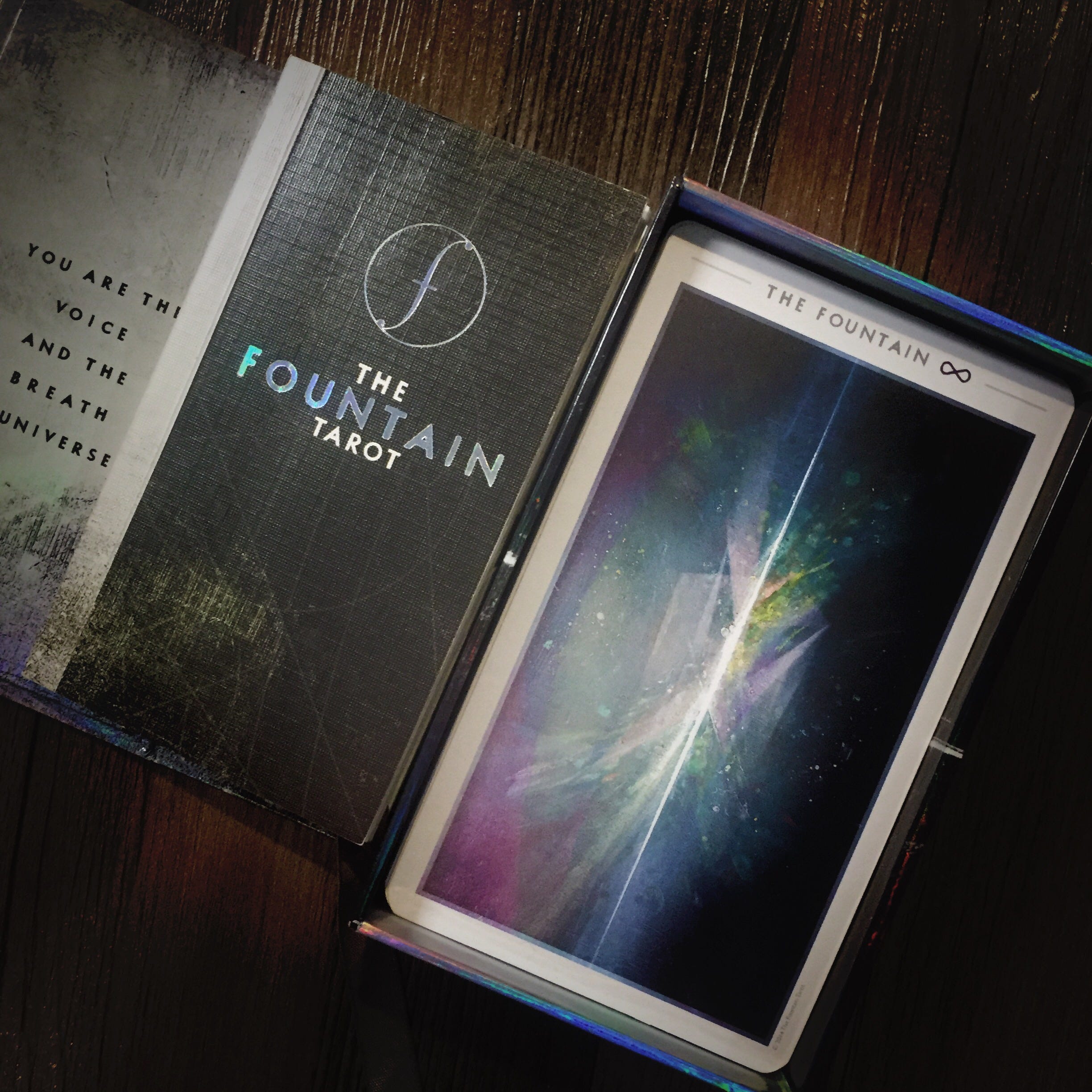
From their book:
“The Fountain exists outside outside and beyond the cycles of birth, death, time, and form. It is the nameless, changeless source of which everything is part. […] It invites you to observe, master less— and to just be, effortless and indistinguishable from life. You are the voice and the breath of universes.”
The Hibert Tarot’s Magic:
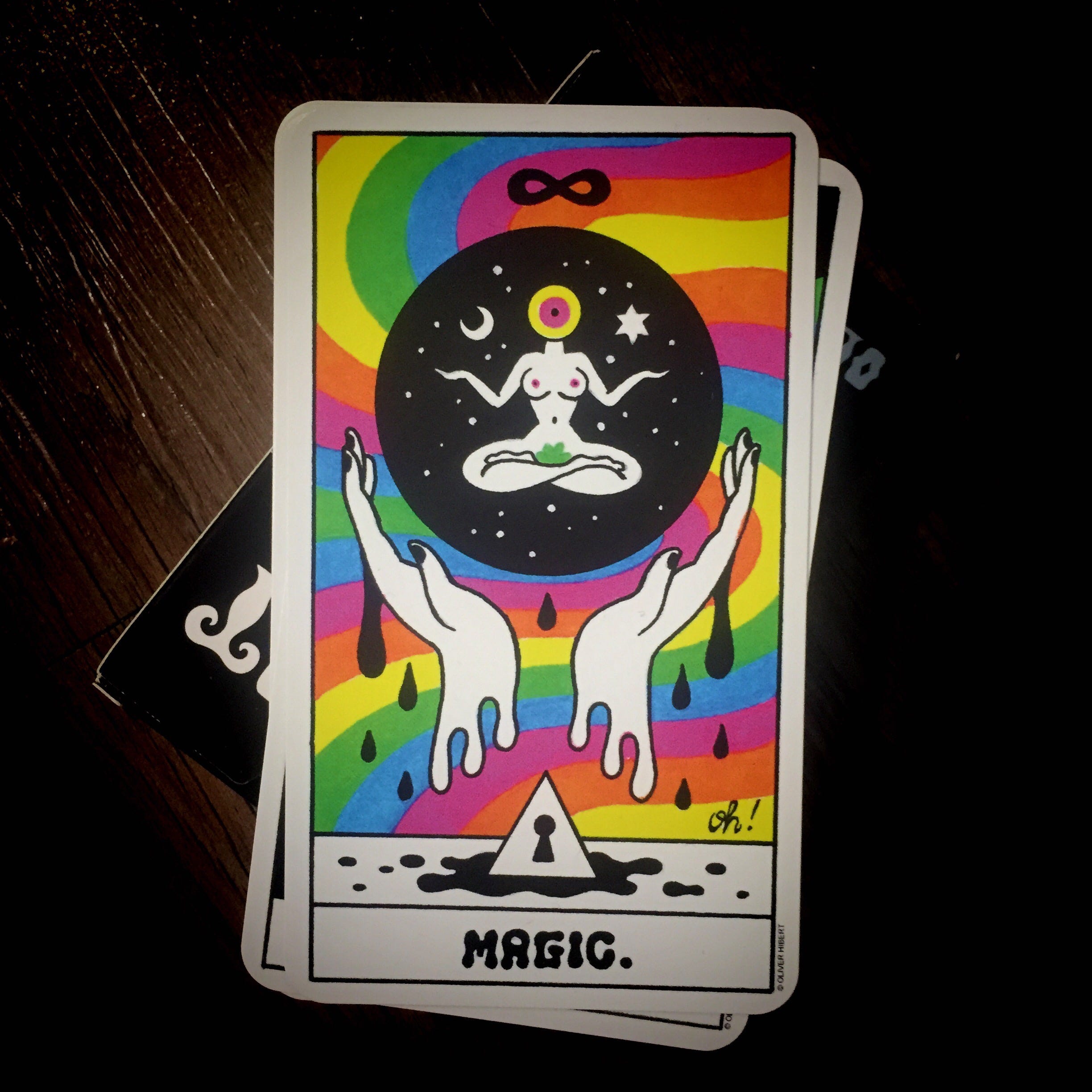
From the artists’s commentary:
“I am no tarot expert and do not claim to be. […] I very much wanted to keep the integrity of the cards and I concentrated on those elements I felt could be changed and developed freely. I began with The Magician and after that, it was clear I had to continue.
I have one simple goal with my own art, to make the world a more interesting place. We all deserve to live in a magical world, and I feel I have a responsibility, through my own choices and imagery and subject matter, to create art that has a transformative effect.”
The Prismavisions’ Rotating ? Arcana, of which I personally have the Winged Boar (each edition of the deck contains new art of card 79, and the current is Reverie):
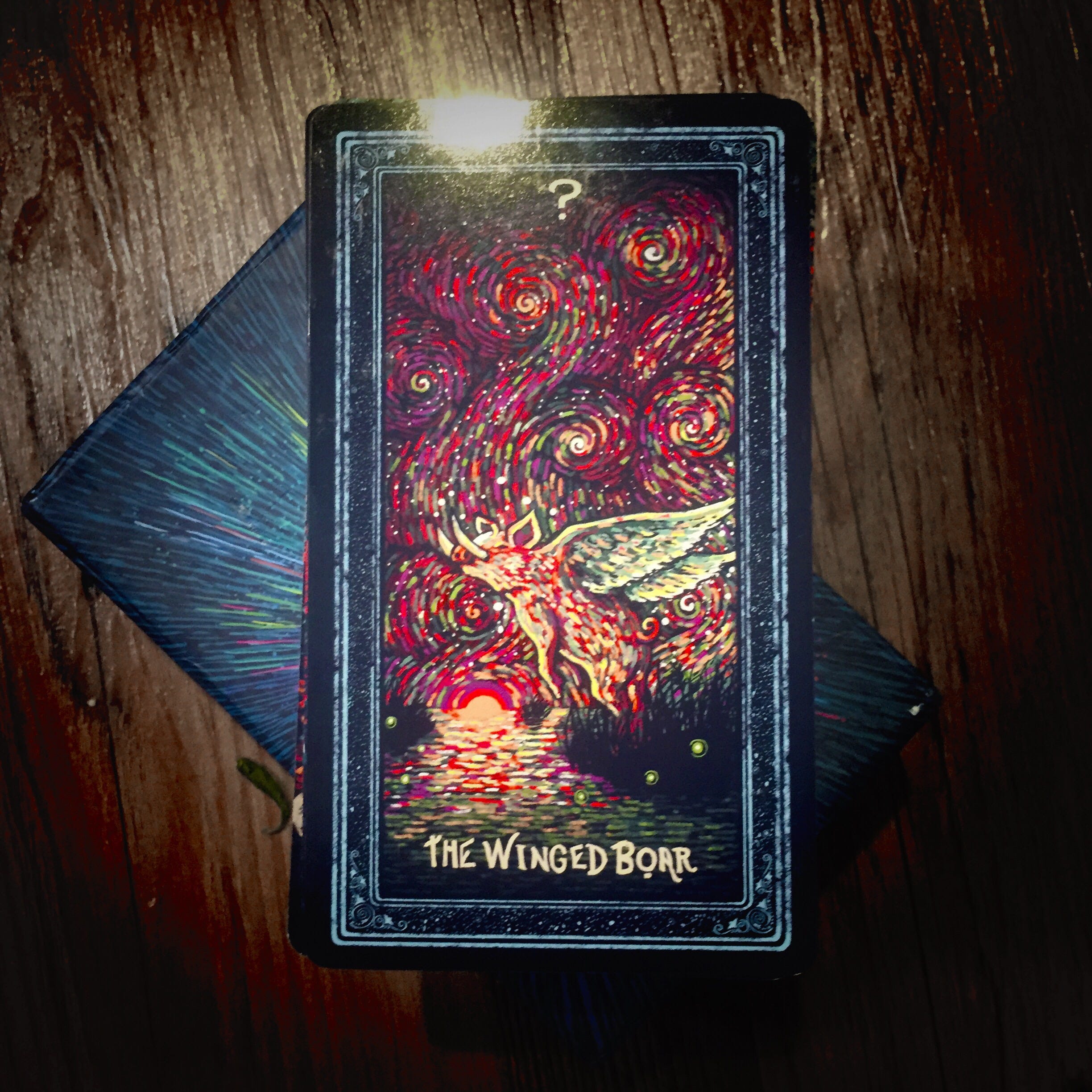
From the book:
“Unlike their cousin the wild boar, often associated with symbolism of war, the winged boar lives in peace and enjoys its abstract existence. The winged boar is an oxymoron because it’s both things at the same time. It’s hot and it’s cold, it’s heavy and it’s light. It’s the third option you usually don’t get.
[…]
It turns out that sometimes the ‘nevers’ actually do happen… sometimes pigs do fly.”
The Pagan Otherworlds’ Seeker:
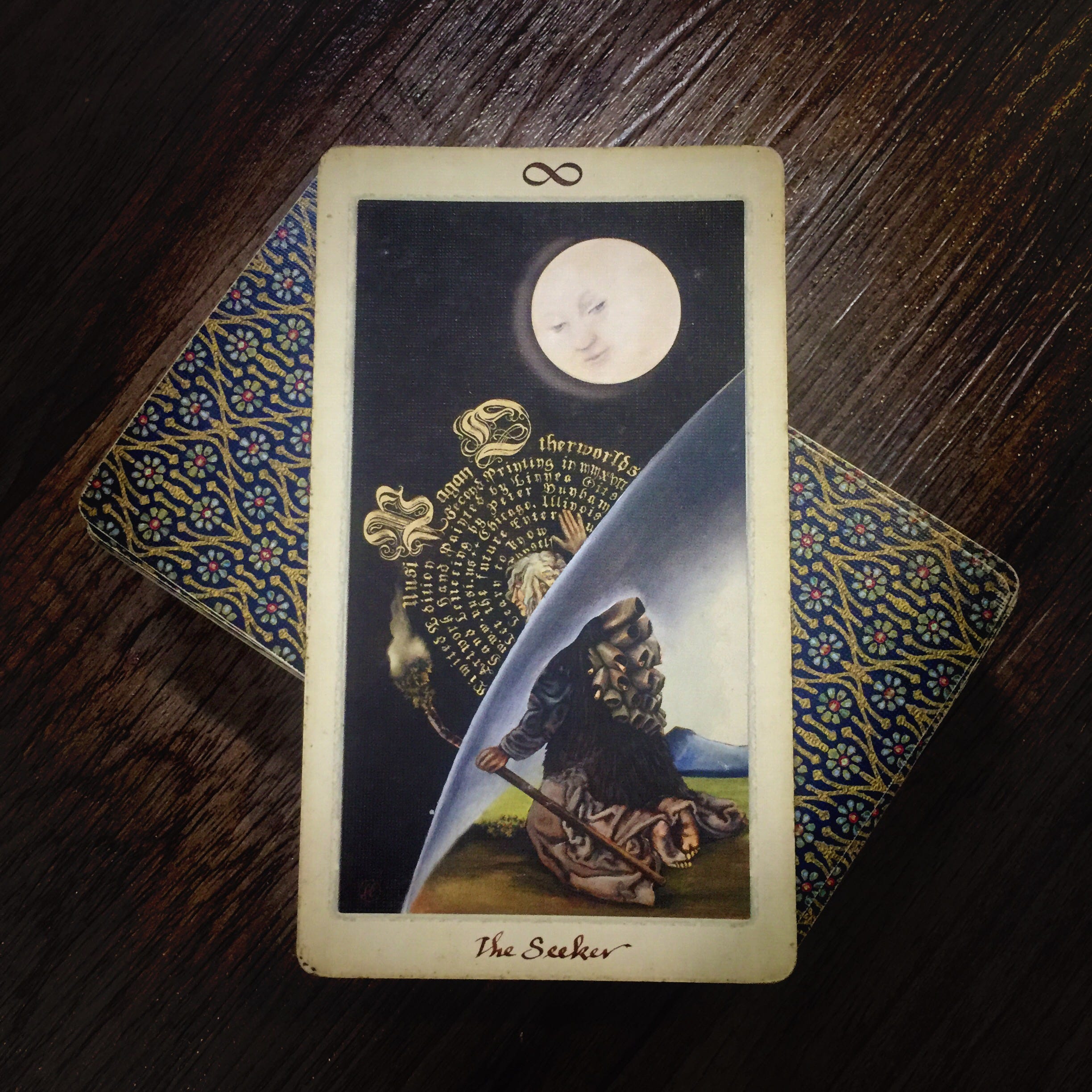
While I do not have a book for this deck, it is clearly a take on the Flammarion engraving, a woodcut of a traveller peering beyond the firmament of heaven to discover the cosmos outside it, suggesting a universe of greater depth and wonder than older systems of astronomy and astrology could fathom. It expresses seeing beyond known (and assumed) possibility.
The Trueblack Tarot’s Anant:
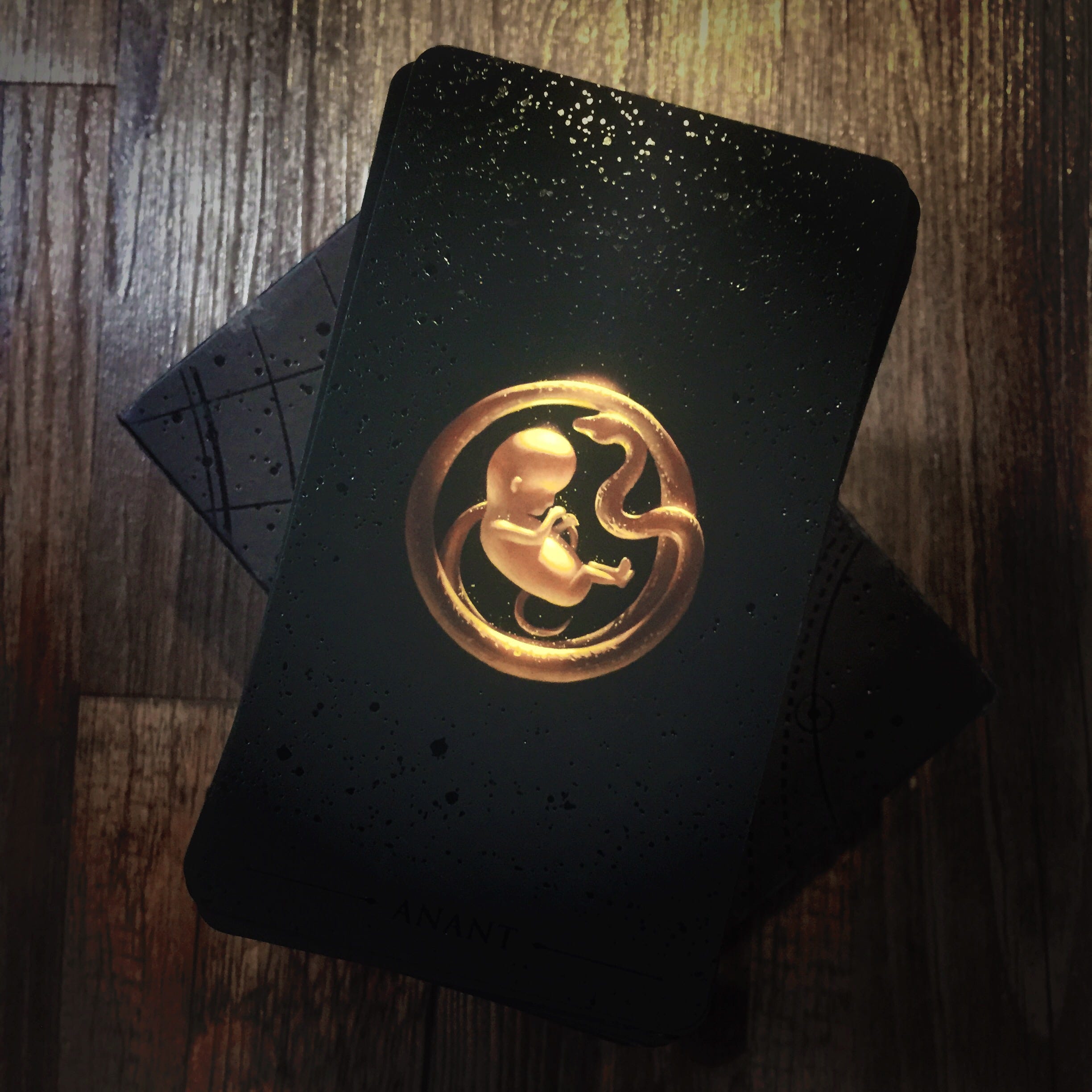
From their book:
Anant refers to the neverending, eternal, and exempt. While all other temporal beings enter existence, grow, and then die, Anant exists outside these constraints and rules.
[…}
Laying in the center of the card is a fetus, the intermediary between the ending and the beginning of the Major Arcana, representing the cyclical nature of eternity.
[…
Around it coils the snake known in Sanskrit texts as Anant-Shesha, usually depicted with five, seven, or a thousand heads. ‘Shesha,’ a term used to identify the ‘remainder’ in mathematics is that which exists when all else ceases.
Each of these warrants its own missive, but this particular piece is dedicated to the principle that underpins card 79: the yearning of Tarot itself to cover more ground. Across all its permutations, this card appeals to possibility. It is the space into which the continuum can grow: visions of the impossible, as well as the universal principle of creation. It is as though there exists a primordial desire for a stronger language of reality spilling out through the work of the artists, even those artists who are not accustomed to practicing Tarot themselves.
The early twentieth century study of the cards was dedicated to the conceit that it was an unbound book, the remnant of some ancient true religion with greater wisdom than contemporary spiritual traditions offered. Today, as Tarot blooms rhizomatically, with each new interpretation of a card adding to the possibility space, it is hard to imagine pursuing that line of reasoning further.
Tarot’s wisdom is still developing: it is becoming more than it ever has been before our eyes, and that is Magic worth our attention. This is, after all, what drove me to begin this publication, to work backwards from the practical art into the growth of the design. Card 79 is a wink from beyond the shuffle, an acknowledgement that there is still so much more to be revealed.
If you want a rabbit hole to explore card 79 conceptually and practically, it is worth thinking about Foucault’s commentary on Borges’ Celestial Emporium of Benevolent Knowledge from the Preface to his Order of Things. in Celestial Emporium, a strange taxonomy is used to group all animals into categories that feel alien. Rather than “mammals” or “cnidarians” or some hierarchical structure that accords with modern modes of classification, Borges claims that an old Chinese encyclopedia organized animals into such disparately defined groupings as “ones belonging to the Emperor,” or “suckling pigs” or “included in the present classification.”
“In the wonderment of this taxonomy, the thing we [learn], is demonstrated as the exotic charm of another system of thought, [and] the limitation of our own, the stark impossibility of thinking that.”
If we imagine Tarot heuristically as a grouping of human experiences into seventy-eight discrete categories, Card 79 invites us to think about the exotic and outlandish means by which this has been accomplished. If 79 is pulled in a practical setting, a clarifying card is almost assuredly necessary to determine what Tarot feels it is failing to articulate, as it is unlikely that the primordial origins of reality are relevant to the querent’s question. There is something that needs to be said that is just out of the cards’ immediate reach. It’s best to think of it as an error message to troubleshoot.