
MISSIVE 34
The Mascot as a Bridge between the Devil and Strength
Baseball is a sport built upon superstition and ritual, and there is cause to believe its rules are modeled on Masonic numerology and geometry. Whether or not the latter is ever historically verified, Hannah Shapero wrote a beautiful essay titled The Diamond Way describing the overtly magical aspects of the sport that transcend its origins:
“Far more than other sports, baseball shows an esoteric structure. The game is played on a geomantically perfect square. Each base stands at what would be the quarters in Western esoteric ritual. These four bases also stand for the four elements, though attributions are variable: Home plate, with its coating of dust, seems to be Earth, while third base is traditionally referred to as the "hot corner," signifying Fire. In the center is the pitcher's mound, a circle in the middle of the square mandala, which speaks to us of the fifth element of Spirit, or the center point of wholeness.
The men on the field hold to their positions as reverently as any Masonic or Hermetic ritualist. In the outfield stand the attendants in the outer courts. On each of the quarters stands a baseman, guarding his sacred trust. The shortstop moves between inner and outer, like swift Hermes, who moves between the worlds. The catcher, at his Earth station, also serves as Guardian of the Threshold; he challenges those who would enter or leave the quadrant as base runners. In the center is the pitcher, or Hierophant, upon whose offerings the course of the ritual depends. Completing the scene are the priests in blue, the umpires, who know the Law and keep the ritual correct.”
So it should come as no surprise that mascots, the strange, discount-rack shamans who wander the field in costume, are also born of a magical framework:
“Originally, the French word mascotte meant lucky charm and was often used as gambling slang, with the hope that a "mascotte" was there to bring luck to the player. The word was finally brought to the mainstream by the 1880 French opera La Mascotte, about an Italian farmer who had a hard time growing crops until he was visited by a mysterious virgin named Bettina, who as long as she remained a virgin, would function as somewhat of a good luck charm. Eventually, the farmer's fortunes turned around.”
The Arcana League tarot deck portrays Strength as one such team mascot, temporarily removing her mask while on break after controlling the Lion from within:
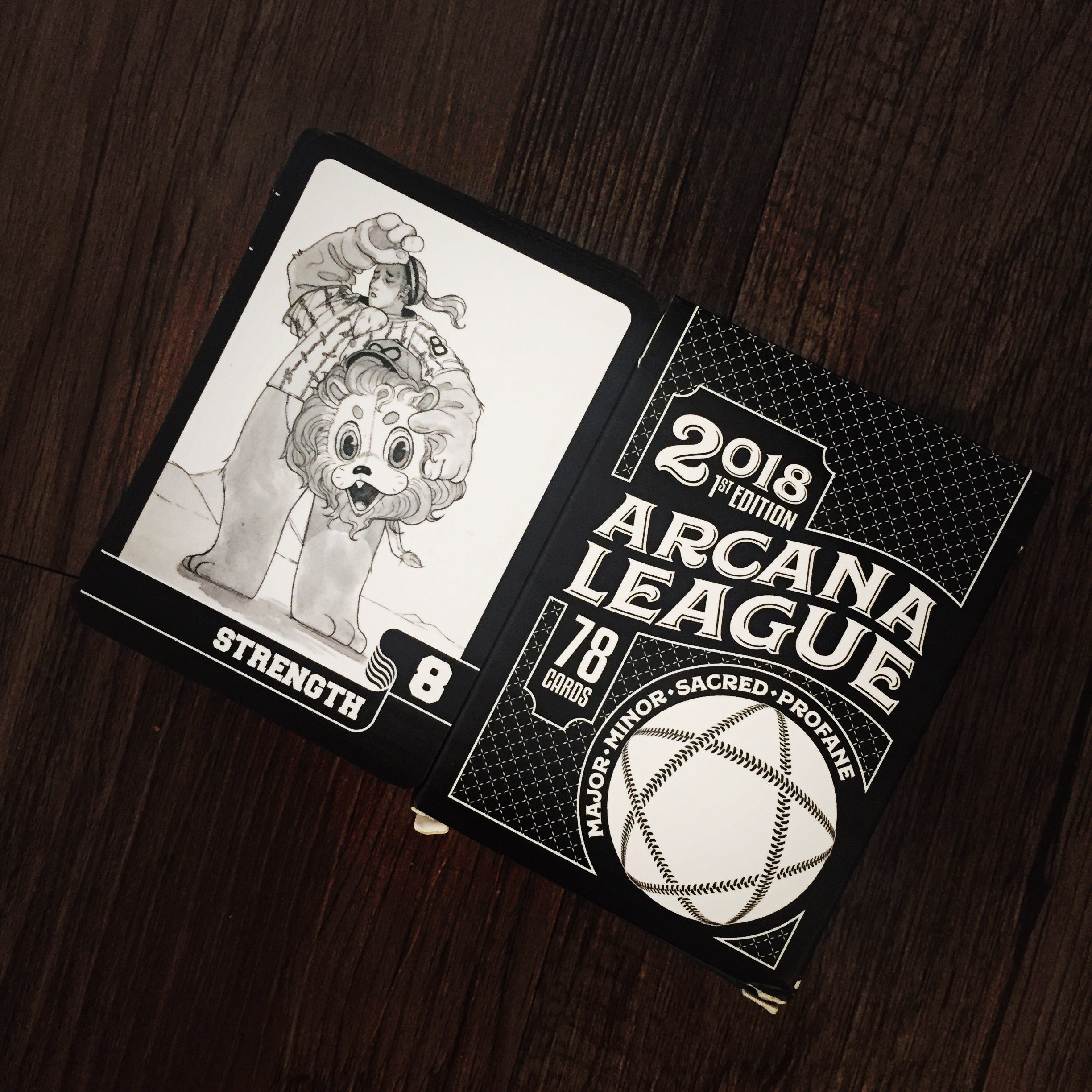
The mascot’s job is to direct the various non-athletic elements of the competition into athletic results; to evoke a vitalistic energy from the crowd by embodying the spirit of the team, then charging the players with their Élan vital. Becoming the Lion is more than just moving around in a swelteringly warm chassis: it is directing the whole organism of the stadium towards sportsmanly victory. When we look at the more traditional portrayals of Arcanum VIII, it is generally understood that the woman handling the lion is a reflection of some invisible, self-control process on the outwardly-facing self; this version illustrates their relationship by portraying this inner-versus-outer geometry more explicitly.
Departing from this temporarily, I would like to examine the portrayal of yet another mascot, who makes a dramatic appearance in the Philly Tarot:
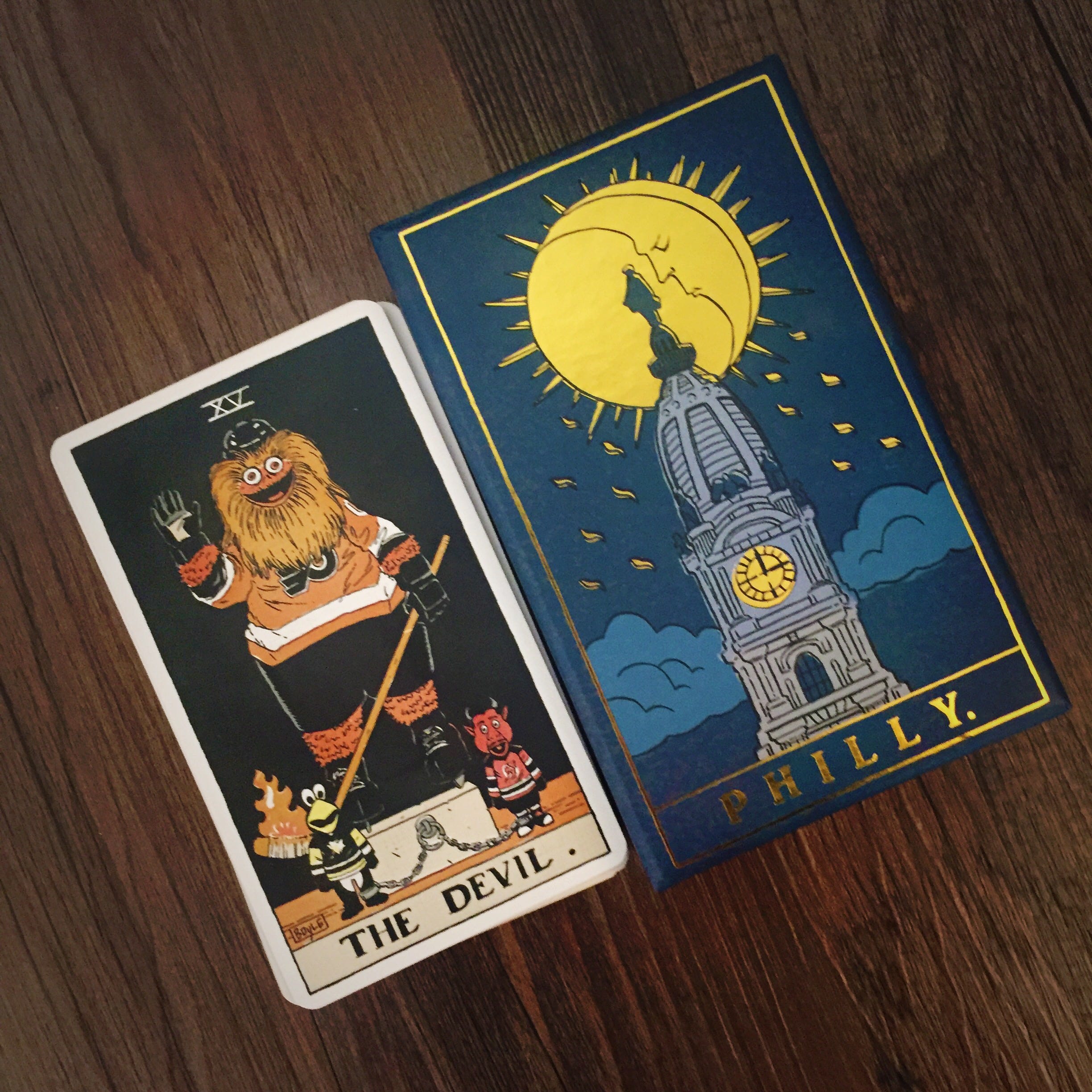
This is, of course, the likeness of Gritty, perhaps the most high profile mascot in the United States, and an avatar of the present moment. Here we see them portrayed as the Devil, the master of id and sin. They reflect our vices and most violent impulses, the ways in which we just can’t help ourselves. And we absolutely love them.
They were introduced to Philadelphia with an origin myth of having been disturbed from some deep, Hadean slumber by construction work, and forced to emerge from depths unknown. As American reality has become more chaotic, Gritty’s maddened rictus has become a signifier of that chaos. City Council member Helen Gym put forward a resolution welcoming Gritty to Philly, noting:
“WHEREAS, Gritty has been described as a 7-foot tall orange hellion, a fuzzy eldritch horror, a ghastly empty-eyed Muppet with a Delco beard, a cross of Snuffleupagus and Oscar the Grouch, a deranged orange lunatic, an acid trip of a mascot, a shaggy orange Wookiee-esque grotesquerie, a non-binary leftist icon, an orange menace, a raging id, and an antihero. He has been characterized as huggable but also potentially insurrectionary, ridiculous, horrifying, unsettling, and absurd…
“As there is a small part of every Philadelphian embedded in the soul of Gritty, he is never alone. Gritty joins a renowned cadre of Philadelphia sports mascot colleagues that will teach him how to keep the spirits of Philadelphia sports fans high despite our inevitable misery… Philadelphia is Philadelphia because of the brotherly love, sisterly affection, and monsterly spirit that binds us together in confronting anyone who dares to speak critically of our beloved city.”
The Philly Tarot guidebook echoes this spirit of chaos:
“XV. The Devil: The Orange Beast
Addiction, chaosUh oh... Are you overindulging your inner, beastly id? Perhaps you don’t care for the welfare of penguins and devils, but maybe you should take stock of your actions before the manic googly-eyed monster within takes over.”
This makes for surprising nuance that highlights the differences between Gritty and traditional mascots, as well as the relationship between Strength and the Devil. Gritty is the beast depicted in VIII without the gentle inner guide; the urges that we do not bridle, and thus instead chain us to their ultimate ends. By extension, the Devil and Strength are linked: is the animal self under control, or does it have us enthralled?
Gritty, like a traditional mascot, is a civic spirit. Though technically within the sphere of hockey, Shapero’s notes still apply:
“The ritual game has a value that is far more abstract and less subject to the dualism of winning and losing. But a failure in ritual, like a loss in baseball, is not eternal: there is always next game or next year. And success in ritual, as in baseball, brings joy to a community and a whole city. It connects sacred and profane, inner and outer worlds. Ritual is sacred play, which brings cosmic inspiration to its participants on common ground.”
This is where Gritty deviates from other mascots, and how they become the Devil: in a cultural moment where we are unable to so much as leave home, they offer a vision of revelry in the streets (Philadelphia is the envy of the nation for its mastery of riotous chaos). When police violence and repression are at their worst, Gritty embodies the ideal of pushing back and not giving a fuck. And so long as stadiums are filled with digitally-inserted spectators and AI-generated noise, while sports bars unjustly go bankrupt, the temptation to embrace a more debauched world will increase.
None of us are in the mood to direct our spirits in a traditional manner, and it shows. On some level, we’re all ready to give in.