
MISSIVE 51
Seriousness and the Knight of Wands Reconsidered
If there is one card that I am biased towards appreciating in Tarot, it is the Knight of Wands: trailblazer and igniter, he brings the impetus that sets matters in motion in accordance with his vision of the world. Whereas the Page is more of a torchbearer, bringing the fire where it is needed, the Knight already possesses it and uses it as he sees fit. This card can represent someone who inspires others and organizes action as easily as it can be someone who brashly pursues upward mobility at a cost to all others. It is a perilous position, and one the reader must reflect upon when considering the weight of their work. Bringing Tarot into someone’s life at a pivotal moment requires extreme care and discernment, as divination is not an art without consequences.
Botanica by Kevin Jay Stanton is a beautiful, meticulously crafted deck that uses the subtle properties and histories of flora to delineate correspondence in Tarot. In doing so, it interrogates the most gruesome possibilities of the Knight of Wands, utilizing the image of a Passionflower:
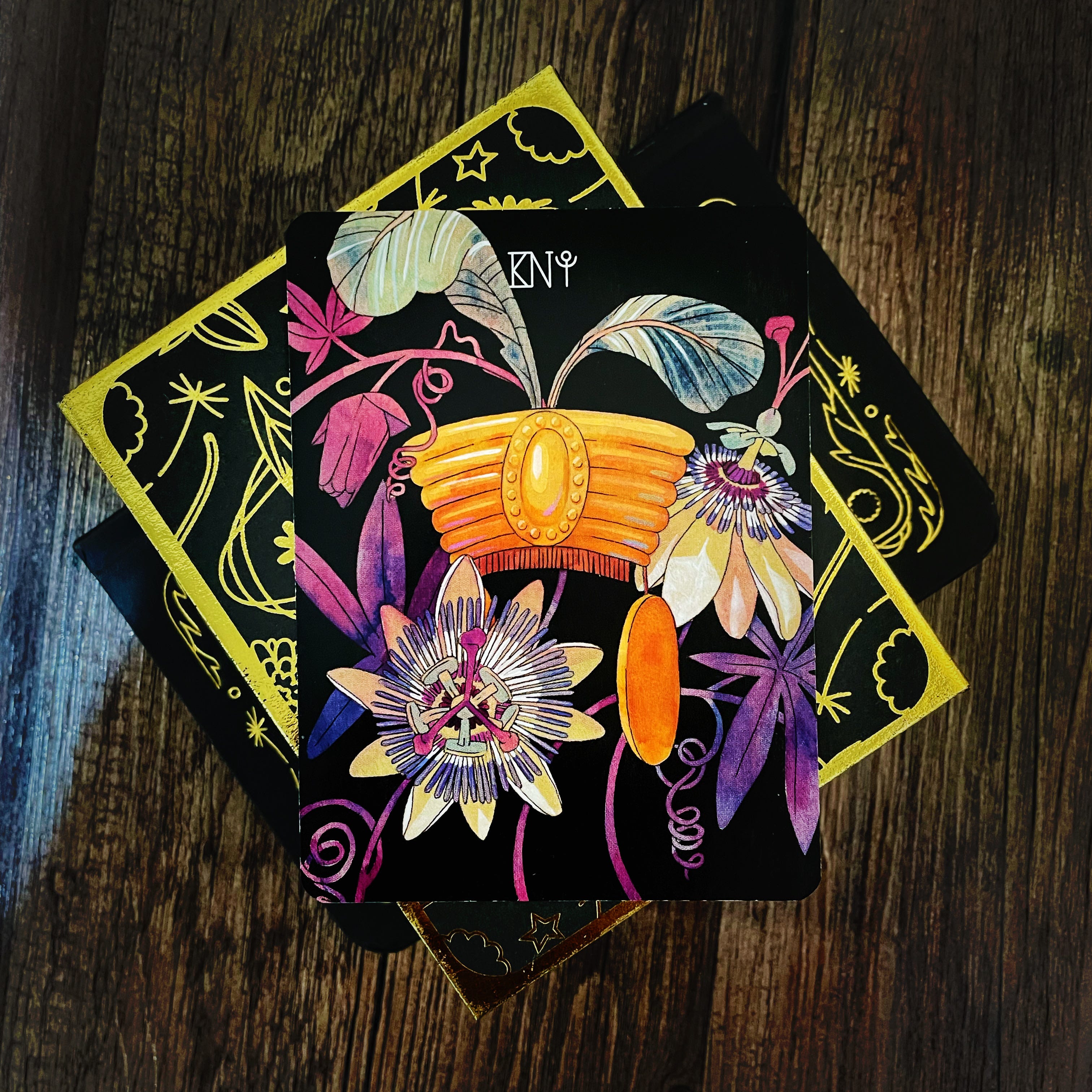
From the book:
“These flowering vines are often mistaken for romantic passion, but the truth behind their name is much darker. Their passion refers to the trials of Jesus, and when the showy flowers were seen by the Jesuit priests upon their arrival in the Americas in the 16th Century, they saw symbols of the Conquistadors’ divine right to conquer and subjugate the indigenous peoples. Every part of the plant was thought to point to this, including the three stigmas as the Holy Trinity, the five anthers as the five wounds, and the delicate filaments as the Crown of Thorns. Although the symbolism of the flower was added by the conquerors, the status symbol on this card is the Ilautu of the last Sapa Inca, the ill-fated Túpac Amaru.”
Such brutality reflected in one of my favorite cards twisted in my gut, but I had to admit it was a correct move, and one which skillfully oriented Tarot as a whole towards the future.
Indeed, just as easily as the Knight of Wands could represent a freedom fighter or advocate for unpopular causes, he could also be a conquistador seeking justification for the most appalling horrors imaginable. The admonition is significant: here is not just the Hell that can result of imposing one’s will upon the world, but also, the danger of inappropriately reading signs towards one’s own ends. The brutal hubris involved in imagining that untold eons of a flower’s evolution holds a secret truth for you and you alone is an important threat embedded in a deck built entirely from the process of interpreting flowers as omens. It’s a warning that divination never happens in a vacuum: what comes of your work, whether you’ve done it right or not, is real.
I find that many practitioners who learn to trust magic tend to do so in a capricious and lighthearted manner. They begin to rely heavily on intuition, and neglect any language that invites interrogation and critique of process. Seriousness in reading cannot be underestimated in its importance: if you are to sink your hands into the stuff of the world, and tinker with possibility, you cannot forget the atrocious things which also dwell here. If you see only positivity, and describe only positivity when reading a card like the Knight of Wands, what are you allowing to burn?
Tread lightly, and exercise humility where you think you see your reality in the cards. You are capable of incredible things, but also terrible things, as is any querent. Do not imagine that merely being spoken to by a divinatory tool exalts the story of your life: it can also condemn you.