
MISSIVE 53
Reading Case Study 1: A Difficult Path from Zero to Two
The querent was interested in she and her husband’s careers, though mostly his, and the cards reflected almost entirely upon his, which was not unexpected from our conversation (“What I want to do is no big deal on way or the other. I know what I have to do”). Much was pivoting on his decisions, and she wanted an analysis of the present circumstances as the two of them navigated waning-pandemic reality.
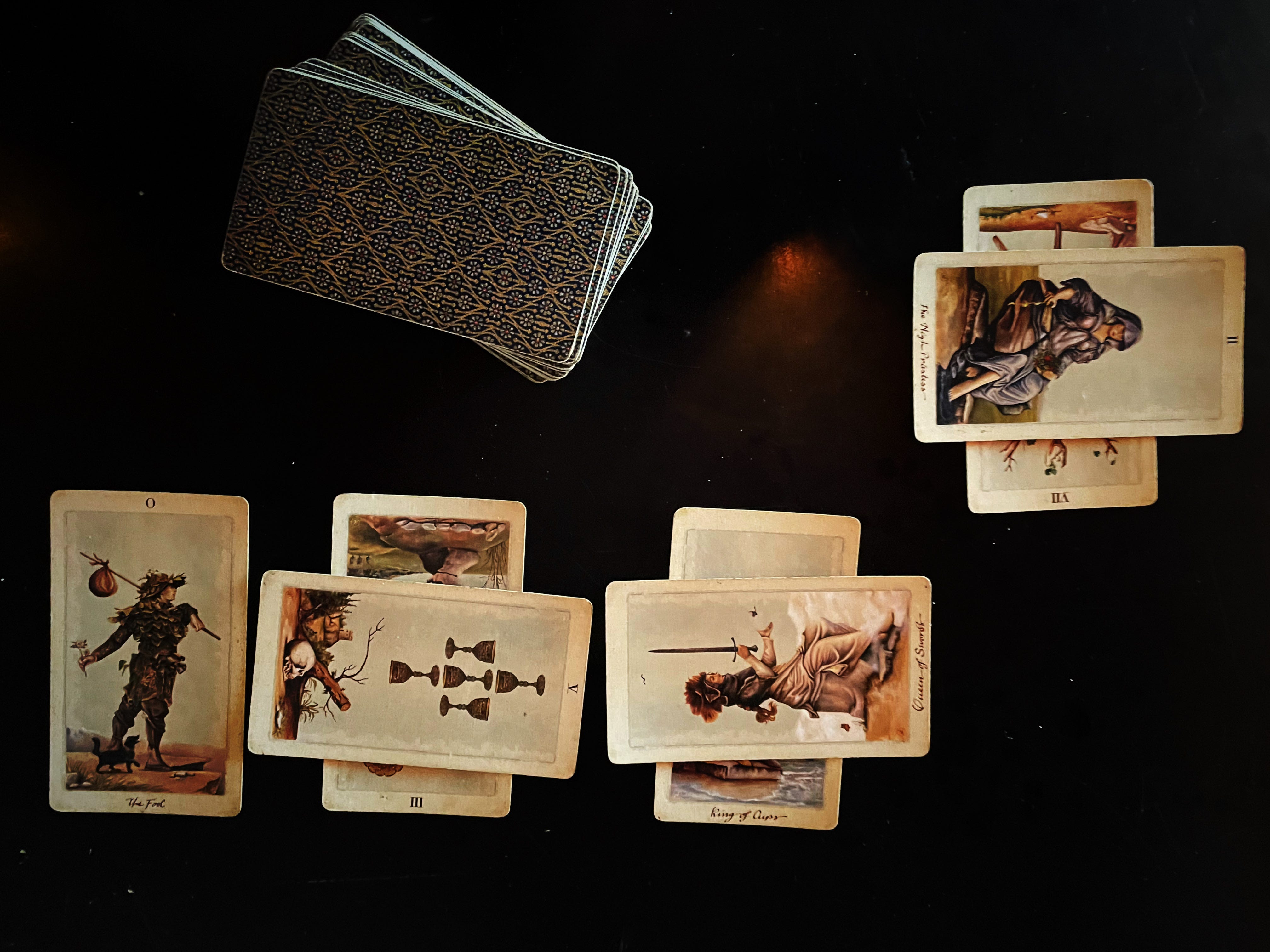
Past: The Fool
Present: Three of Pentacles upturned crossed by the Five of Cups
Future: The King of Cups crossed by the Queen of Swords
Advice: The Seven of Wands upturned crossed by the High Priestess
Let’s go through them one by one.
—
Past: The Fool
This is the classic new journey. A tabula being rasa’d, a story beginning. Zero. It was the most trivial part of the reading, by far. Though important, it does not necessarily require much elaboration, as it exists as a sort of handshake, setting the stage that the deck is indeed talking about the same thing as the querent.
The querent informed me, at this point, that her husband had chosen to start a brand new venture on the far side of the pandemic and open the restaurant he’s always wanted to run. The present circumstances were indeed part of a complete career relaunch for him, and her decisions from here were contingent upon his own professional project. He had become well connected in the local service industry and finally ready to pursue his dream.
—
Present: Three of Pentacles upturned crossed by the Five of Cups
The Three of Pentacles tends to indicate mutually beneficial material relationships among unlike parties, and especially, in matters like this, tends to describe contracts. The classic Waite-Smith version shows the relationship involved between a master mason, clergyman, and architect in the building of a cathedral. The version in this deck is a set of rocks stacked delicately atop one another, illustrating the material results of their alliance. There is precarity in negotiating and maintaining mutual benefit, and here, that precarity is front and center.
Now, take the reversal as an incomplete version of this story, and color it with the Five of Cups, the Lord of Disappointment. It is the card of mourning, in which three of the cups have spilled, yet two remain upright. This suggests a contractual negotiation on the material level having come to difficulty and loss on an interpersonal level. The parties involved could not get along.
We move, here, from the handshake, to a focusing. The grand vision of the Fool was the whole of the past, and here we have a very specific, concrete correspondence in reality. Things are not going as planned. Whatever comes next will not be the original conception of the project.
The problem, I learned at this point, is that her husband had two other people he envisioned as his partners in this restaurant, both of whom were part of the planning, yet neither chose, ultimately, to participate in the business’s execution. The vision of partnership, core to the ideal vision of his passion project, had broken down from the start. That the Three really was a negotiation among three business partners with differing roles is an amusing bit of serendipity: it could have been two, or four, or thirty-four, and the reading would hold, but sometimes the cards really are reflected explicitly in the world. Furthermore, the Three cups spilled in the Five of Cups on top of a Three of Pentacles augment the interpretation. Other social connections and resources must be considered than those planned for.
This is one of those memorable, irreproducible anomalies. I don’t expect I will see this exact configuration ever again.
—
Future: The King of Cups crossed by the Queen of Swords
The King of Cups crossed by the Queen of Swords is a troublesome dichotomy. Here we have a navigation of the project’s future that pits strategy imposed upon the world against one’s own personal connections and social existence; the executive urge to facilitate human interaction and flow pitted against the cold necessities outlined by the Queen. This is a very intense interaction, difficult tension for a leader to navigate.
The King of Cups is in a strong position in his network, being someone who knows all the right people. But the Queen of Swords is the figure who must take decisive action in her domain to ensure events play out as intended, regardless of consequences. Getting these two to play nice isn’t a simple matter, and there will be pain involved once they’ve achieved equilibrium.
Reading court cards is always hard, no matter your skill. They tend to define the scope and relationship of the querent to others explicitly. When drawn alone, there is often the question of, “is this the querent, or someone else, or nobody at all?” As the subject (the husband) was someone trying to establish their own position and authority, it made sense that this was the shape of the challenges faced once the throne was established. There was no need to imagine other figures beyond him and the querent, because we were already talking about someone’s personal court and ambitions.
The querent told me that this was often a challenge; that in previous endeavors, her husband’s kindness had resulted in trouble with people whose interests in his business were far more exploitative than beneficial. Balancing the Queen’s all-important discernment with a desire to work with beloved colleagues would be critical to achieving success going forward, as this appeared to be a front on which he had been consistently burned in the past, and already at least once in the present. Here, she could potentially help. Though far from the Queen of Swords archetype herself, she knew him well enough to check his gut when needed.
—
Advice: The Seven of Wands upturned crossed by the High Priestess
This suggested to me an outnumbered circumstance, explicitly colored by the High Priestess’s control over the veil of mysteries. It stood out sharply to me as a place where many conflicts of passion are being fought, but in particular, key aspects of these bouts are not even known yet. I look at this, and verbalize my perception: that the cards intend to say “this is already a struggle with more fronts than were envisioned previously, and a number of significant ones aren’t even known at this time.”
This was well received. When an advice position exists or is added to a spread, it has an added burden for the reader, which is, from your human perspective, what should a person do given the parameters? And sometimes, even often, there is no fair presumption. I usually avoid advice positions unless requested or truly prudent. Who am I to say anything at all about what someone should do, especially a restauranteur? I am no restauranteur. However, Tarot is not trying to write the menu for them, just speak of who they are in context. Acknowledging that scope had not been addressed was critical. Inventory of knowns and unknowns would be vital.
—
Overall:
Each segment of this reading’s temporal progression— Past, Present, and Future— was unique in its construction. There was no large scale rhyme from one card to the next. However, we did see two Majors in close proximity and progression: The Fool (0) in the Past, and the High Priestess (II) in the advice position for the future: a general Card English communication of: “you don’t really know what this story looks like yet.” Critical to this is understanding the missing piece of the bridge: The Magician (I), the provider of the instruments needed for initiation.
The primary takeaway I could communicate was that scope needed to be assessed, which was not something unknown to the querent. The High Priestess spoke to the challenge of the Seven of Wands, beyond just “this is a passion project with many risks.” What it meant to achieve success was on the other side of an unknowable barrier due to the number of variables already in play. Scope was out of control, and the consequences of this were recently evinced by the Three of Pentacles arrangement collapsing. How many other such presumptions had been made?
The best I could really offer, here, was that inventory should be taken of all risks, challenges, and incomplete plans. In general, when the future is unclear, any decent management strategy recommends having next steps on all uncertainties. When a veil like the High Priestess’s is presented, especially following the Fool, it is clear that you do not know what exactly it is you’ve gotten yourself into just yet. Everything was at risk until he audited his vision thoroughly.
—
Takeaways:
Watch for handshake cards. The deck has ways of saying “hey, you!” to grab the attention of a querent and demand engagement. A more technical term for this might be what Louis Althusser would call interpellation: a point beyond which whether or not you acknowledge that you are being addressed, it is too late to not react. Once you’ve been hailed by Tarot, even to pretend you do not recognize the hail is still to be engaged in the event of divination. In this manner, the cards speak to, and impact, even the nonbeliever or bad faith querent.
Here, at least, this was very easy, as our handshake was The Fool: the wiping of a slate and starting over after a previous saga in life. Even so, seventy-seven times out of seventy-eight, it will be a different card. Once Tarot connects, it tends to then pivot to a focus: “now that I have your attention, let’s talk about the matter at hand.”
Here, that focus was a very straightforward transition: I don’t think there’s anything else in the deck that could have described the present scenario better than this Five on Three entanglement: social disappointment and loss marking the collapse of a material arrangement among three business partners. It doesn’t get more explicit than this, and calls the querent to urgency in assessing this shift in expectation.
The advice position, then, provides some advice in regards to what the cards have chosen to focus on. It asks to assess why this failed. How many more idealizations have the potential to come undone in the same manner? The project was already showing signs of scope creep which could prevent it from ever getting off the ground.
The advice position is always in conversation, first and foremost, with the future card (and outcome card if you feel the need to separate them, though I usually do not). That spread position here showed a court drama which would need to be navigated, and thus, the Advice position shows a method for navigating it. Where are you leaving yourself open to a disappointment like the one you just faced?
—
The last, but perhaps most important thing I will note about this reading is etiquette. I would not have been able to navigate this reading without seriousness and humility.
I am not a restauranteur, nor do I formally know the querent’s husband. I would not pretend to imagine I could make a call on supplies or or staffing or menu choices. I would not pretend that I know the current health of their relationship. I also cannot pretend that, by providing a Tarot reading about these matters, I am not now an influence here, however slightly. Another conversation concerning their lives has now happened that would not have happened otherwise. This will color the way their next interaction happens, whether I like it or not.
When dealing with serious matters, let your querent speak and never, ever presume that you have some sage knowledge about themselves that they do not, because you do not. You are an interpreter of a voice that nobody fully understands. Walk through the progressions in front of you, and let them speak as they are comfortable. Should you choose to provide advice beyond your personal, consensual awareness, this does not make you some sort of intuitive reading ace: it just makes you an asshole.