
MISSIVE 55
The Domain of the King of Swords
There’s an anecdote that I first discovered through Robert Anton Wilson’s Cosmic Trigger, a wonderful series of books in which he describes the various events and errors that defined his philosophy over the course of his life:
“For years I have been telling the story of Prince Peter Ouspensky, who in his early years in the Gurdjieff Work did not understand Gurdjieff’s insistence that most people are so deeply hypnotized that they act exactly like mechanisms. Then, shortly after World War I started, Ouspensky saw a truck headed for the front, carrying artificial legs. Suddenly, looking at a truck full of artificial legs to replace legs that had not yet been blown off, but would certainly be blown off very soon, Ouspensky understood that all human behavior on the large, historical scale is so mechanical that it can be mathematically predicted.”
It is hard not to remember this passage repeatedly during our present catastrophe of mass death and suffering: a pandemic which continues to kill thousands each day, yet according to those in power, also ended months ago, and also never happened. The failure of rational controls to end the disaster has resulted in all of these histories existing in intellectual superposition. There’s a prevailing sense of hopelessness of late; that nothing more can be done. While we may see all this chaos and imagine that the various cogs of human behavior have loosed onto the floor of the reality factory, we must also consider that they are spinning onward as they always have.
Wilson would say that our individual “reality tunnels” formed from our differing contexts, definitions, and assumptions prevent us from understanding each other in a meaningful way. His multi-model approach to thinking argues that these differences can be made into an advantage, however, especially philosophically and magically: so long as we accept that we are not seeing the universe objectively, being willing to intellectually work with multiple frameworks of thought and belief at once, even when they contradict, can provide greater insight into the world at large.
At the same time, it is not a particularly effective strategy for collective problem solving. The pessimistic vision that everyone is similarly wrong dismisses the real value of human experience altogether. When I spoke about Wilson’s methods with an interesting scholar at a bar in Boston several years ago, he dismissed it outright. “Could someone really think with a belief system they don’t actually accept? Wouldn’t someone who simply moves from assumption to assumption completely miss the depth of conviction that someone who, say, dedicates their life to a monastery feels?”
Indeed, the multi-model approach, by necessity, cannot incorporate all models, and is stunted by the presumption that it can. Modes of thinking cannot be worn and discarded like clothing, as they are integrated into the way we exist in the world. The intellect is not some external rational force that can be separated from the rest of the self. Even our systems of presumed-to-be objective logic, all our ifs and thens and causes and effects, are recognizable in the manner in which we experience time. No mind is sharp enough to allow the self to escape itself.
It is for this reason that I deeply enjoy the Fountain Tarot’s vision of the King of Swords:
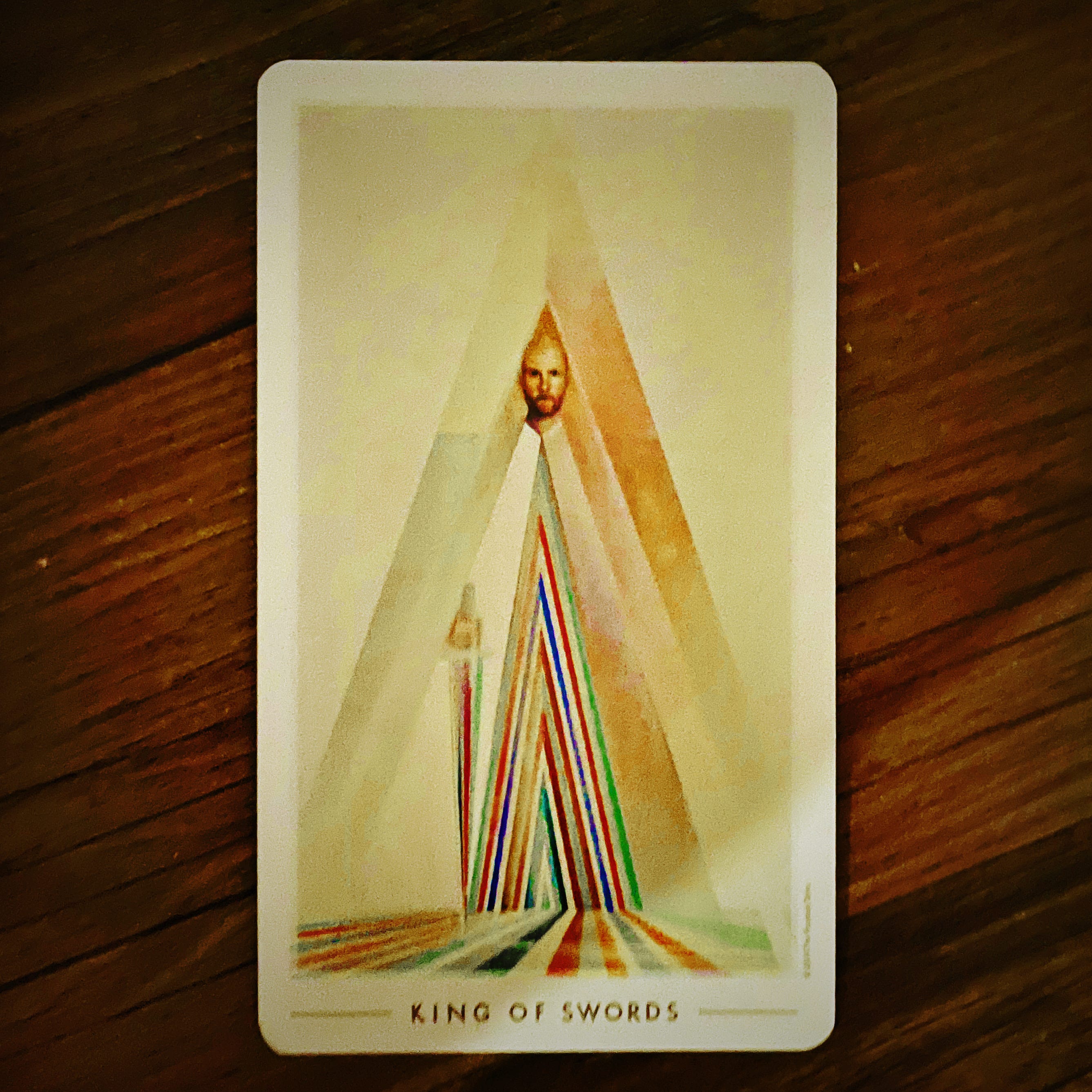
This court card tends to be seen as an intellectual authority, the Fire of Air, who has mastered his discipline and domain through the power of reason. Here, he is a prism through which the world we know is refracted into separate rays of color; in his presence, it can be understood entirely through him. His body, sword, surroundings, and the ground he stands on are all abstractions born from his presence, a single geometric form. It is for this reason that his rational understanding seems absolute.
It is through such a portrayal that we can begin to understand the conviction that often prevents achievement of any kind of intellectual consensus at scale. For all his wisdom, the King of Swords is incapable of knowing a world that is not recontextualized through his experience of it. It is deeply frustrating, especially when the flaws are blatantly visible from outside, that a simple explanation isn’t enough to adjust his mind. To challenge the intellect of someone else is to challenge their memory, their culture, their material conditions, their heart, their body, their desires, their colleagues, their faith. Thoughts are not ephemeral, no matter how much we wish them to be. They are materially us. Our biases are ourselves.
When we dissect the way others think from outside, we can quickly become the King of Swords, coldly dismissing fools for being blatantly incorrect, yet looking down in horrified frustration when they fail to arrive at what we consider to be obvious conclusions. It is only in understanding how difficult it is to change our own minds, and just how much our thoughts are made of, that we can effectively begin to disassemble those machines of suffering which churn ever onward. After all, they’re made of us, too. Perhaps we can use that knowledge to our advantage.