
MISSIVE 57
Geometry, Tensegrity, and the Three of Pentacles
Threes in Tarot tend to be forms of covenant or contract, whether with others or the self. The Waite-Smith Three of Pentacles demonstrates this fairly directly, showing a meeting between three figures: a monk, a figure in a liripipe (likely an architect or scholar), and a mason, as indicated by his apron and setting maul. They stand beneath the arch of a cathedral, presumably the product of their collective work:
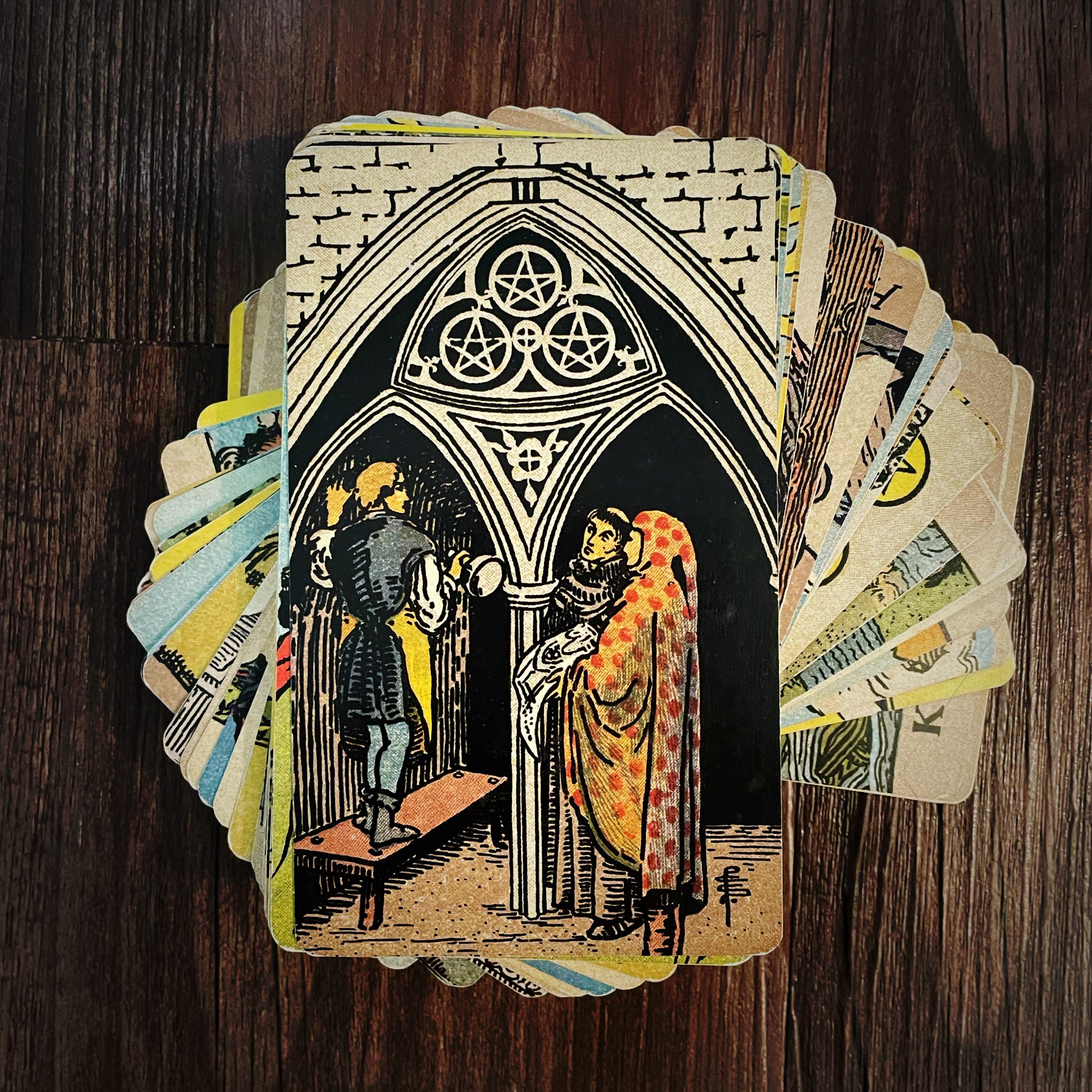
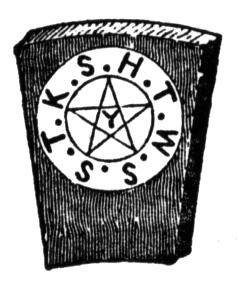
20th century occultism drew heavily from Freemasonry, so it is no surprise to find the construction of an arch, with the pentacles themselves appearing at the peak. Traditionally, this is the position of the keystone, which uses the tension between curving stones to support the whole of the structure. Keystones have traditionally been ritual objects of masons, with some even bearing pentacles themselves:
The figures and the architecture are analogous, and speak to the core of the card: multiple unlike forces converging to achieve a unified purpose. Neither the mason, nor the monk, nor the architect, could build the cathedral without the other two. Their covenant produces the sacred, seen as this fourth symbol above them.
In Thoth tradition decks, this card is understood as The Lord of Work, and the product of Mars in Capricorn. This can be understood multiple ways, but one of the most interesting contextually is tension and force used towards pragmatic ends. The stones in an arch simultaneously press against and support one another, producing a counterintuitive stability. This category of deck, however, tends to shift towards more abstract imagery, leaning towards the tetrahedral:
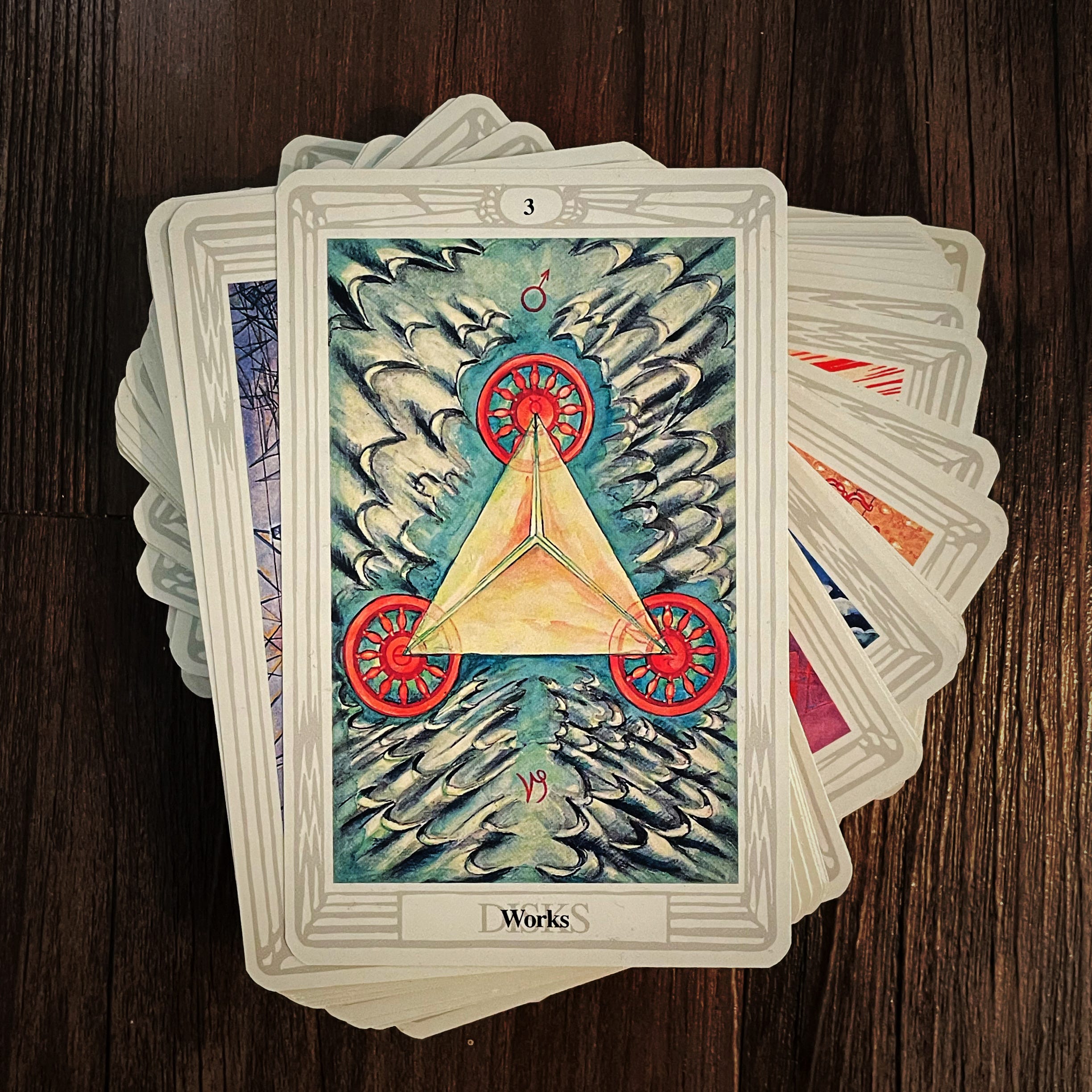
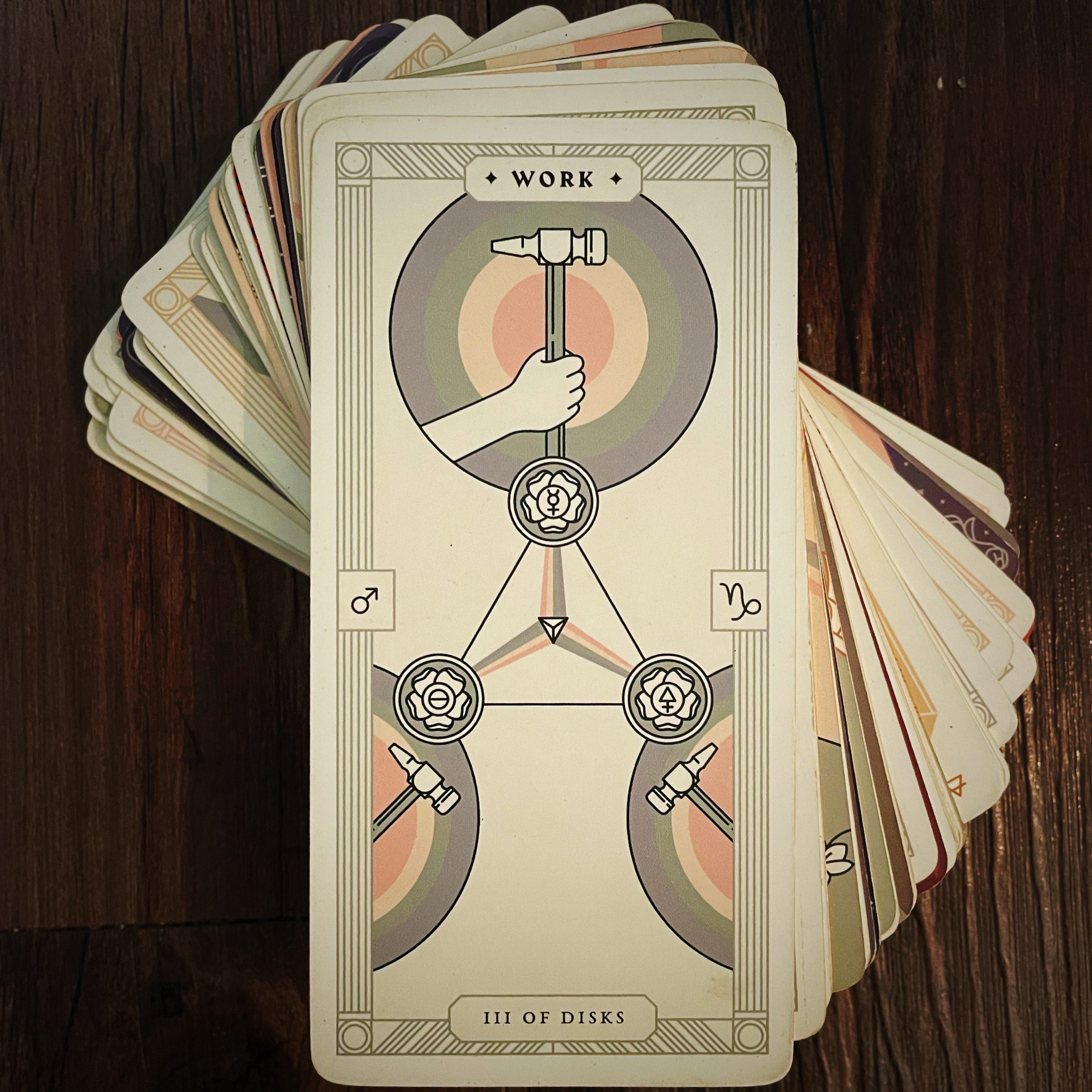
The tetrahedron is the most stable three-dimensional solid, and distributes force evenly when pressure or shear is applied to any vertex. This structure also emerges naturally, as it is the closest possible packing configuration of spheres of force to construct. By simply taking three equilateral triangles and conjoining them on exactly one side, a fourth, identical triangle manifests, producing the maximum amount of rigidity possible in a solid. In this way, it is perhaps the simplest natural expression of a whole being greater than the sum of its parts.
A modern conceptual cousin to these forms is the 3-prism, a tensegrity structure invented by R. Buckminster Fuller:
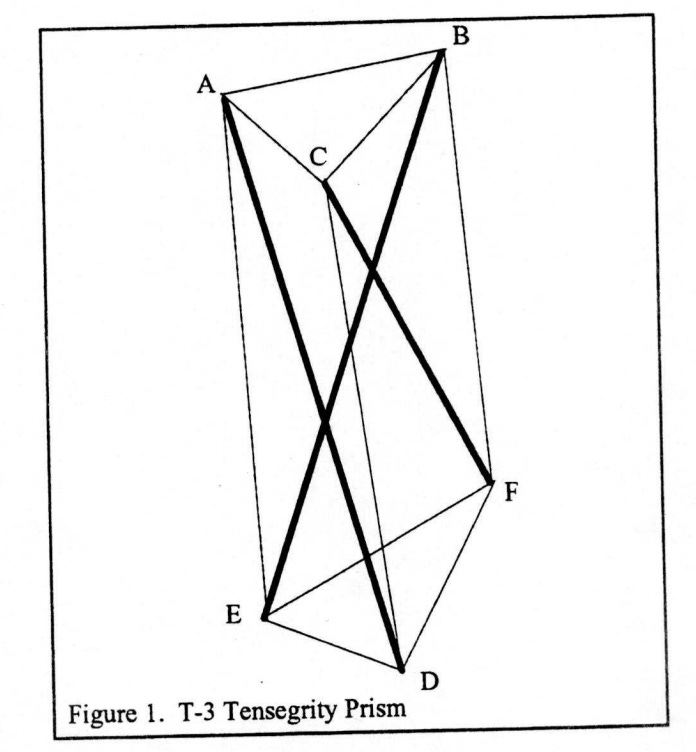
Though not self-organizing, like tetrahedral structures, it is self-erecting: the three bars (bold lines), held together by cables in tension (thin lines), will attempt to return to this particular state if deformed or strained in any manner. With three cables attached to each bar, an interior becomes apparent: three skewed tetrahedrons pulling each other into their present shape. Perhaps this form will be in some future deck’s Three.
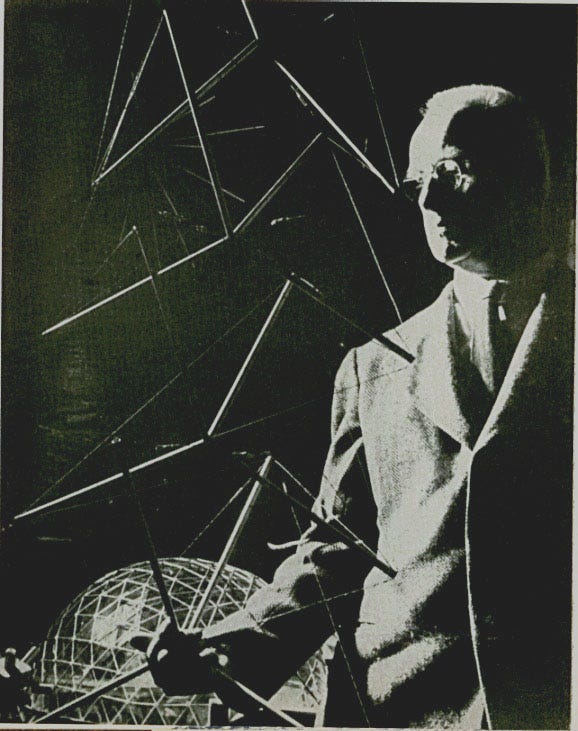
It is interesting to me, then, that in his own words on the invention of Tensegrity structures, Fuller describes a very similar synthesis to that depicted in the Waite-Smith Three of Pentacles as his ideal mode of design:
“It is a sad fact that the world of patronized design is the last area of commonly accepted social behavior where piracy is considered ethical. Patrons hire designers to steal their competitors' work. Patrons hire designers to steal other non-professional designers' fresh-new crops of potential economic growth. Only by joining forces will the architect-, scientist-, engineer-artists be able to eliminate this intellectual cancer of the regenerative processes.”
His architect-scientist-engineer synthesis is not so different from Smith’s architect-monk-mason when it comes to this same manner of construction. The correct collection of unlike skills produces extraordinary ends. Fuller saw little difference between the way humans organized and the simplest crystalline structures of nature, and in his models, their dynamics were largely interchangeable.
In all structure is potential energy, a secret fire of attraction and repulsion that allows for stability. This particular arcanum is the reminder of that: every material foundation is at odds with itself and gravity (After all, The Tower is the card of Mars- the limitations of structure tested). There is no shape without force, no static form without a dynamic lattice within. So it is, also, in the dynamic of labor in a social or collaborative context. While the Three of Cups speaks of harmonic and voluntary bonds, the Three of Coins speaks of the necessary bonds for extraordinary ends.