
MISSIVE 19
When Pigs Fly - Defiance and Card 79 as The Winged Boar
When Medusa was slain, Chrysaor was either born either from her bleeding neck, or coagulated into being when her blood reached the sea; there is more than one telling. While in some depictions, Chrysaor is simply a figure with a golden sword (hence his namesake), in others, he is a winged boar, contrasting his more famous brother, Pegasus, who was born simultaneously.
There’s a strange vitality seen in the remains of Medusa (whose monstrous existence was an injustice dealt to her): her eyes continue to petrify, and every drop of blood spilled by her severed head congeals into a new serpent. Her visage has appeared on protective amulets for thousands of years, including the flag of Sicily itself. Her vengeance is undying, yet aids humanity through magic.
I like to imagine that these two strange-yet-good-hearted creatures emerging from her wound were the end to Medusa’s tragedy, a reminder of her actual pure spirit revealed in her final moments. Yet why did her death result in the birth of a winged boar, of all things? I conjecture that there is a small yet powerful mystery embedded here, the kind of thing you have to see to believe.
A 1586 Latin to English dictionary for children includes a proverb: “Pigs fly in the air with their tails forward.” It’s an example of a statement that is valid yet has false premises: the idea of a pig taking flight is seen as the ur-example of something that does not make sense. Eventually, this mutates into an idiom: “when pigs fly.”
This type of phrase has a name: an adynaton. A statement made with the sincere belief that it is not only not true, but can never be true. There are countless examples across different languages, but flying pigs are special. Their invocation is a wager against reality that can be won, especially now, in age of heavier-than-air travel.
John Steinbeck adopted the winged boar as a personal sigil, crudely renaming it the “Pigasus.” With dutiful irreverence, he would sign it with broken Latin: “Ad astra per alia porci.” There is an obvious grammatical error here, thought it is almost assuredly trolling with what we might call “pig latin.” By his account, he had been told by a professor that he would be a novelist when pigs flew, and he thenceforth made it a personal sticking point, a triumphant yet humble joke with a failure baked in.
In the lates 60s, the short-lived American Youth International Party attempted to run a “Pigasus” for president, in defiance of the local Democratic National Convention in Chicago. Before the party leaders could interpret a statement of intent from their porcine candidate, they were arrested for inciting riots. While the fate of their animal companion is unknown, all were eventually acquitted of their alleged crimes, as well as of contempt of court. This was just one of the many of the wild events surrounding the Chicago Seven and their trial.
There’s a bold defiance to the winged boar that perhaps stems back to its birth in Medusa’s final moments: a sense of comical and joyous release in the face of reality’s cruel stricture. Where Pegasus is perhaps an emblem of the unblemished good of Medusa’s soul in service to the heroic, Chrysaor is her last laugh incarnate.
The Prismavisions Tarot’s Winged Boar was called out in an earlier missive on Card 79, but I felt it deserved its own writing:
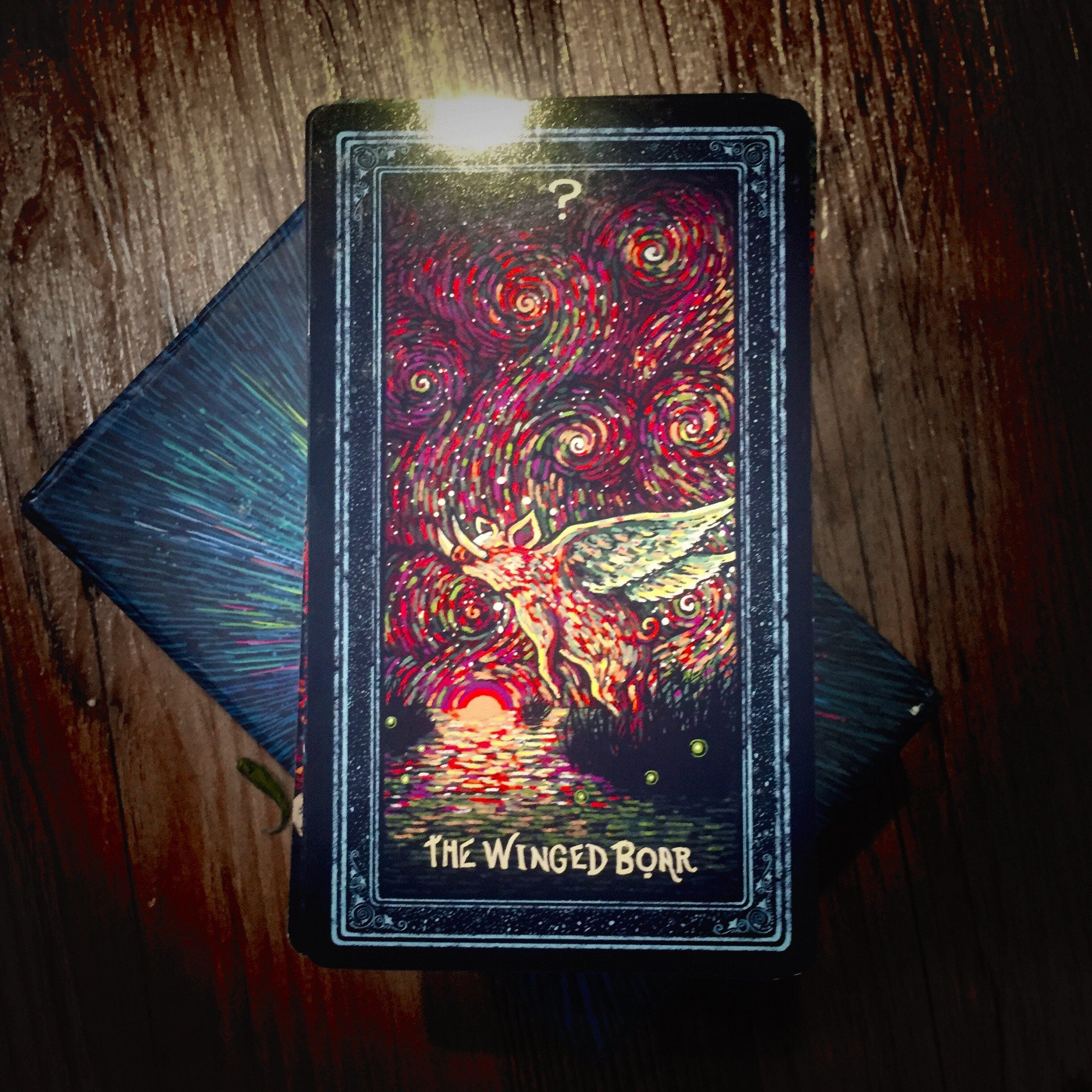
The book wrote of it in the following manner:
“Unlike their cousin the wild boar, often associated with symbolism of war, the winged boar lives in peace and enjoys its abstract existence. The winged boar is an oxymoron because it’s both things at the same time. It’s hot and it’s cold, it’s heavy and it’s light. It’s the third option you usually don’t get.
[…]
It turns out that sometimes the ‘nevers’ actually do happen… sometimes pigs do fly.”
The Winged Boar slips outside the field of seventy-eight categories of possibility and gives us a chance to laugh in the face of the allegedly inevitable. Here’s where it doesn’t work. Not only can the gods be overcome; they can be mocked. Even when everything’s gone to hell, the impossible can still show through, and offer us a bit of levity. Those moments are worth celebrating.